
✅ Quick answer
If the puffiness on your cheekbones changes with sleep, allergies, salt, or time of day, it’s more likely related to fluid. If it stays in the same spot and shape day after day, it may be more structural, such as malar bags. Many women over 40 have a combination of both, so the key is learning which pattern you’re seeing before deciding what to try next.

Why this can be so confusing
One day the puffiness on your cheekbones seems worse, and the next day it looks better. Or maybe it’s been there for years and never really changes.
That’s why so many women wonder if they’re dealing with simple puffiness, malar bags, or something else entirely.
The good news is you don’t need to know complicated anatomy to get a better idea. In many cases, paying attention to where the fullness sits, when it changes, and what seems to trigger it can tell you more than staring at the mirror trying to decide what to call it.
In this guide, I’ll walk you through a few simple observations that can help you figure out whether your cheekbone puffiness behaves more like temporary fluid, something more structural, or a combination of both. From there, you’ll have a better idea which at-home approaches are actually worth trying—and which ones probably won’t make much difference.
Start by looking at how the puffiness behaves
Before trying creams, massage, or other treatments, spend a few days simply observing the area.
One of the biggest clues isn’t what the puffiness looks like in a single photo. It’s whether it changes.
Temporary fluid often comes and goes. It may look worse some mornings, improve as the day goes on, or become more noticeable after salty foods, allergies, or a poor night’s sleep.
Structural fullness, such as malar bags, usually behaves differently. While it can look a little puffier on some days, the overall shape and location tend to stay much the same.
Instead of asking, “What is this?” try asking:
“How does it behave?”
That simple shift can help you decide whether gentle de-puffing methods are worth trying or whether you’re looking at something that’s less likely to change.
| Check | Ask yourself | Why it matters |
|---|---|---|
|
Location |
Where does the fullness sit? | Helps distinguish under-eye puffiness, malar bags, and festoons. |
|
Timing |
Does it change during the day? | Changing puffiness often points toward fluid. |
|
Triggers |
What makes it worse? | Salt, allergies, crying, and poor sleep can make fluid-related puffiness more noticeable. |
Below, you can look at each clue a little more closely so you can decide which pattern sounds most like what you’re seeing.
Check the exact location
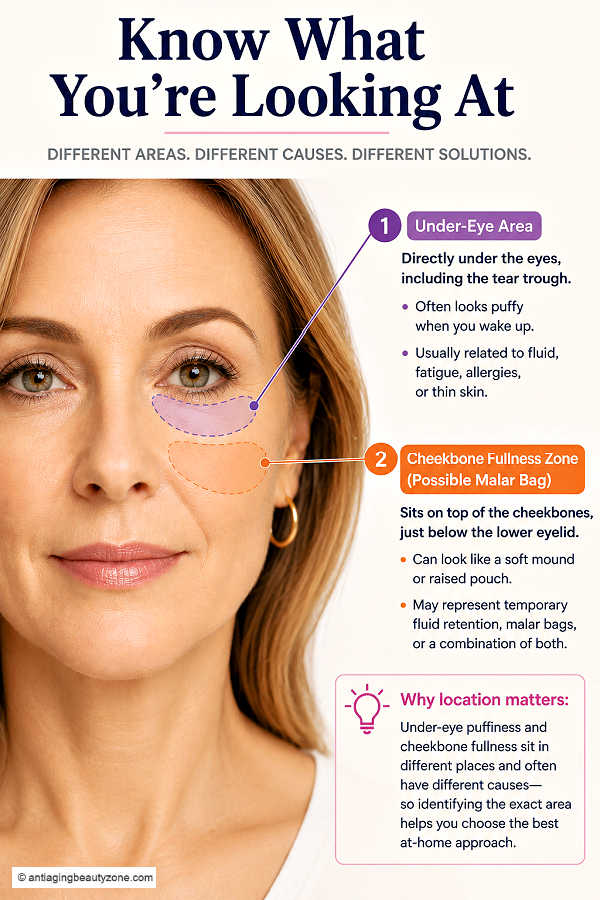
Start by noticing where the fullness sits.
Ask yourself:
- Is it directly under your eyes?
- Does it sit over the cheekbone?
- Does it extend lower onto the upper cheek?
- Is it the same on both sides of your face?
The location is one of the first clues that can help you tell the difference between under-eye puffiness, malar bags, and festoons. While these conditions can look similar at first glance, they don’t always appear in the same place.
Check the timing
Don’t judge the puffiness based on one glance in the mirror.
Instead, pay attention to when it looks its best and when it looks its worst.
Ask yourself:
- Is it more noticeable when you first wake up?
- Does it improve as the day goes on?
- Does it stay about the same from morning until night?
- Has it looked much the same for weeks or even months?
Puffiness that changes throughout the day usually points to fluid. If it’s mainly under your eyes—not your cheekbones—see my review of the tightening products I’ve personally tested that might help smooth the area.
On the other hand, fullness that stays in the same place and looks very similar day after day may be more consistent with malar bags or another structural change.
Don’t worry if it isn’t completely one or the other. Many women notice that some fullness is always there, but it becomes more noticeable on certain days. We’ll talk about that later because it’s actually quite common.
Check the triggers
Sometimes the biggest clue isn’t where the puffiness is—it’s what seems to make it worse.
Over the next few days, pay attention to whether the fullness changes after things like:
- Sleeping on one side
- Eating a salty meal
- Drinking alcohol
- Seasonal allergies
- Crying
- Hot, humid weather
- A poor night’s sleep
If the puffiness becomes more noticeable after one or more of these triggers, there’s a better chance that temporary fluid retention is contributing to what you’re seeing.
If the area looks much the same regardless of sleep, diet, weather, or allergies, the fullness may be less influenced by fluid and more related to your underlying facial structure.
You don’t have to keep a detailed journal. Simply taking a quick look in the mirror under similar lighting for two or three days can reveal patterns you might otherwise miss.
Signs the puffiness behaves more like temporary fluid
If your cheekbone puffiness changes from day to day, there’s a good chance fluid is contributing to what you’re seeing.

That doesn’t necessarily mean you don’t have malar bags or another structural change. It simply means temporary swelling may be making the area look more noticeable on certain days.
The goal isn’t to diagnose yourself. It’s to recognize the patterns that often point toward fluid so you can decide whether simple at-home steps are worth trying.
It changes noticeably
One of the strongest clues is that the puffiness doesn’t always look the same.
You might notice that:
- It’s puffier some mornings than others.
- It looks better by afternoon.
- Some days the area appears softer or less noticeable.
- The amount of fullness changes from one day to the next.
That kind of change is often a sign that temporary fluid retention is playing at least some role.
It’s also common for women over 40 to have a little structural fullness with extra fluid layered on top, so don’t worry if the pattern isn’t perfectly clear.
It responds to common triggers
Fluid-related puffiness often becomes more noticeable after certain everyday triggers.
For example, you may find the area looks puffier after:
- A salty meal
- Drinking alcohol
- Seasonal allergies
- Crying
- Sleeping flat or on one side
- A hot, humid day
These triggers don’t usually create malar bags, but they can make existing puffiness look worse by causing extra fluid to collect in the area.
If you’ve noticed your cheekbone puffiness becomes more noticeable after one of these situations, it’s another clue that temporary swelling may be part of what you’re seeing.
It may improve with simple de-puffing habits
If fluid is contributing to the puffiness, you may notice at least some improvement with simple at-home steps.
For example, some women find it helps to:
- Sleep with their head slightly elevated.
- Use a cool compress for a few minutes.
- Stay well hydrated.
- Manage allergy flare-ups.
- Give the area time to settle after waking up.
The improvement is often subtle rather than dramatic, and it may not happen every time.
If these habits consistently make the area look a little better, it’s another sign that temporary fluid is likely playing a role.
If they make little or no difference over time, the fullness may be less related to fluid and more related to your facial structure.
If you’re looking for more ideas to reduce everyday puffiness, I also share the simple habits and home treatments I use in my guide on how to reduce puffy eyes. Many of them can help when temporary fluid is part of the problem.
Signs the puffiness behaves more like structure
If the fullness looks almost the same day after day, it’s less likely to be caused by temporary fluid alone.
That doesn’t mean fluid never affects the area. Even structural fullness can look a little puffier after a salty meal, allergies, or a poor night’s sleep.
It stays in the same spot and shape
One of the biggest clues is consistency.
Ask yourself:
- Does the fullness stay in the same place every day?
- Does it have the same general shape?
- Does it look similar whether it’s morning or evening?
If your answer is yes, you’re more likely looking at a structural change, such as malar bags, rather than temporary swelling alone.
It doesn’t change much with common triggers
Most people notice at least a little extra puffiness after things like allergies, crying, or a salty dinner.
But if the fullness is still there on your “good” days—when you’ve slept well, feel hydrated, and don’t have obvious triggers—it may be less influenced by fluid than you hoped.
That’s why some women feel frustrated after trying one de-puffing trick after another. The problem isn’t necessarily the technique. It may be that fluid isn’t the main reason the area looks full.
De-puffing habits make very little difference
Simple at-home habits can still help your face look fresher overall, but they may not noticeably change the fullness itself.
For example, you might notice that:
- Your eyes look less puffy.
- Your skin looks brighter.
- Your face feels more refreshed.
Yet the cheekbone fullness remains in the same place.
When that happens, it’s another clue that the area may be more structural than fluid-related.
When it looks like a mix of both
Here’s something that doesn’t get talked about enough: it doesn’t always have to be one or the other.
Many women over 40 seem to have a combination of stable fullness with extra puffiness layered on top.
That means some of what you’re seeing may be part of your facial structure, while some of it changes with sleep, allergies, fluid retention, or other everyday triggers.
That’s also why it’s important not to assume every swollen-looking area is a true malar bag. Many women have a combination of structural fullness and temporary puffiness, and learning the difference can help you choose more realistic at-home approaches.
A stable base with extra puffiness layered on top
Imagine the cheekbone area already has a little fullness that never completely goes away.
Now add a poor night’s sleep, allergy season, crying, or a salty dinner.
The extra fluid can temporarily make that same area look larger, even though the underlying fullness hasn’t really changed.
That’s why some mornings you may think, “Wow, this looks so much worse today,” only to have it improve a little by afternoon.
Why this matters
Understanding this can save you a lot of frustration.
If some of the puffiness is caused by fluid, gentle de-puffing habits may help the area look a little better.
But if there’s also a structural component, those same habits probably won’t make the fullness disappear completely.
Instead of expecting one cream, massage technique, or beauty trick to erase everything, it’s often more realistic to aim for making the area look a little less puffy and a little more refreshed.
Choose the next step based on what you found
By now, you should have a better idea whether your cheekbone puffiness behaves more like temporary fluid, something more structural, or a combination of both.
That doesn’t mean you’ve diagnosed the problem. It simply means you’re in a much better position to choose realistic next steps instead of guessing.
If it behaves more like fluid
If the puffiness changes noticeably from day to day, start with simple habits that support healthy fluid balance before spending money on expensive treatments.
For example, you might:
- Pay attention to your sleep position.
- Reduce obvious triggers like excess salt or alcohol when possible.
- Manage seasonal allergies if they’re contributing to swelling.
- If you’re wondering whether massage is worth trying, I explain whether massage can help malar bags or festoons.
The key is to change one thing at a time so you can tell what’s actually helping.
If it behaves more like structure
If the fullness stays in the same place regardless of sleep, diet, or other common triggers, it may be time to adjust your expectations.
Simple at-home habits can still help your face look fresher overall, but they probably won’t make structural fullness disappear.
If you’re still unsure whether you’re looking at malar bags or festoons, this simple guide on malar bags vs festoons can help you understand what you’re seeing and why each one behaves differently.
If you’re still not sure
If you’re still not sure, that’s okay. You don’t have to figure it out after looking in the mirror once.
Instead, watch the area for a few days under similar lighting.
Notice:
- Whether the fullness changes.
- When it looks its best and worst.
- Whether common triggers seem to affect it.
- Whether simple de-puffing habits make any difference.
Sometimes the pattern becomes much clearer after a few days than it does in a single moment.
What this page can—and can’t—tell you
This guide is designed to help you observe patterns, not diagnose yourself.
If it helped you understand why your cheekbone puffiness behaves the way it does, you’ve already taken an important first step toward choosing more realistic solutions.
What it can’t do is tell you exactly what’s causing the fullness or guarantee which treatment will work best.
But by paying attention to location, timing, and triggers, you’ll be much less likely to waste time or money chasing solutions that don’t match what you’re actually seeing.
Want More?
I share quick routines, beauty tweaks, and what’s working for me — straight to your inbox. Join the Club and get this free Cheek Shaper Video.


About the Author:
Linda Robison is an anti-aging advisor for women over 40, sharing natural methods, facial exercises, and beauty routines she’s personally tested over the years for smoother, firmer-looking skin. She spent nearly 15 years as an Anti-Aging Health Advisor at the Life Extension Foundation and has been testing facial anti-aging techniques for over 30 years, including training in Carolyn’s Facial Fitness. Her tips have been featured in GB News and Beauty Box Magazine. You can also view her background on LinkedIn. For more everyday tips follow along on Pinterest.
Found this helpful? Tap the 💙 in the bottom right corner
SHARE OR SAVE THIS 💗
SHARE OR SAVE FOR LATER:
Trending Products