
Disclosure: As an affiliate partner and Amazon Associate, I earn from qualifying purchases.
✅ Quick answer
A Kansa wand shouldn’t leave your skin feeling scraped, burning, or increasingly tender. If it does, the cause is usually too much pressure, not enough facial oil, or using the tool when your skin is already more sensitive than usual. In most cases, a few simple adjustments are all it takes to make your next session more comfortable.
One thing I’ve noticed from using a Kansa wand for over 10 years is that it’s actually one of the gentlest tools I use on my face. When my skin has felt a little more sensitive afterward, it usually wasn’t because of the wand itself.
More often, my skin was already a little stressed from something else, like exfoliating, using a stronger skincare product, or simply trying too many treatments too close together.
Here’s how to tell what’s normal, what isn’t, and the simple changes that can help keep your Kansa wand routine comfortable.
Note: If you’re just getting started, my complete guide on using a Kansa wand explains the basic technique, massage strokes, and what to expect from your first session.

What a comfortable Kansa wand session should feel like
If you’re new to using a Kansa wand, it can be hard to know whether what you’re feeling is normal or a sign that something needs to change.
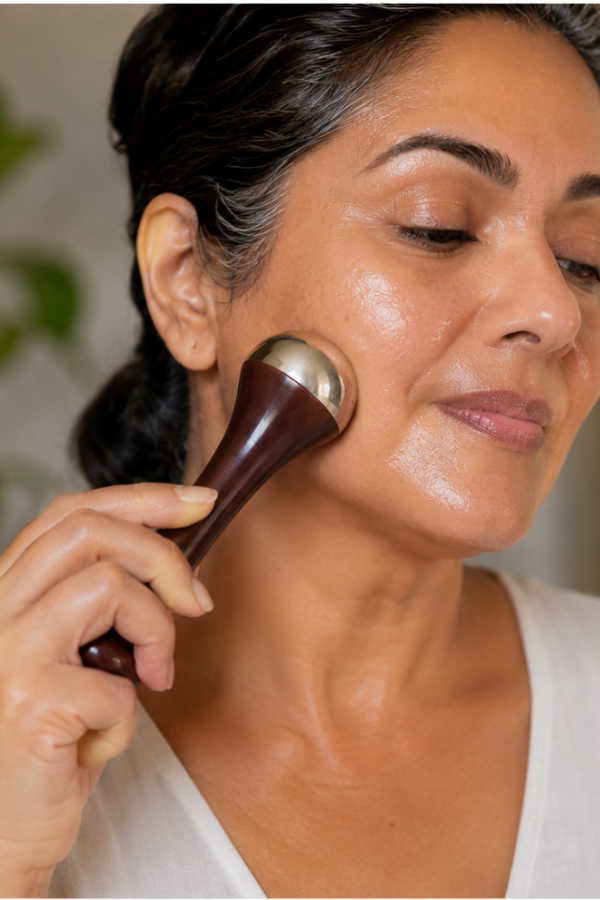
When I’m using mine, my skin feels relaxed—not irritated. The wand glides easily over a light layer of facial oil, and my skin may look slightly pink for a few minutes afterward because of the gentle massage. It should never feel like it’s scraping, tugging, or leaving your face sore.
Normal signs after a session
It’s common to notice a few mild changes after using a Kansa wand. These usually settle down quickly and aren’t a sign that you’ve irritated your skin.
- A slight feeling of warmth while you’re using the wand.
- Mild pinkness that fades fairly quickly.
- Skin that feels relaxed and comfortable afterward.
- A temporary gray residue on the wand or skin, which is a normal reaction between the Kansa metal and your facial oil—not a sign that your skin is irritated.
Signs something isn’t right
If your skin feels uncomfortable instead of relaxed, it’s worth paying attention. A Kansa wand shouldn’t leave your skin feeling raw or increasingly irritated.
Stop using your Kansa wand and give your skin a break if you notice:
- Burning or stinging while you’re using it.
- Skin that feels sore or tender afterward.
- Redness that continues instead of gradually settling down.
- Your skin feels raw, unusually sensitive, or uncomfortable after your session.
If that happens, don’t assume the Kansa wand is to blame. More often, it’s a sign that your skin needed a gentler approach—or that it wasn’t the best day for facial massage.
Some people worry they’ve damaged their skin, but many of the common myths surrounding Kansa wands simply aren’t true.
Common reasons a Kansa wand may cause irritation
If your skin felt irritated after using a Kansa wand, don’t assume the tool is to blame. In most cases, the problem comes down to how the wand was used or what condition your skin was already in. These are the four most common reasons I’ve found.
 I’ve found that some facial oils designed for massage stay slippery longer than lighter facial oils. They often let me finish a full face and neck massage without needing to reapply as much oil.
Your skin isn’t slippery enough
Not using enough oil or serum is one of the biggest issues I’ve found when using the Kansa wand. Especially if your skin is sensitive or dry. Your wand should always glide smoothly across your skin. If it starts dragging or tugging, your skin probably needs more facial oil. Friction can make your skin feel uncomfortable and may be mistaken for irritation from the wand itself.
- Apply enough facial oil before you begin.
- Add another drop or two if the wand starts to drag.
- Stop if your skin feels like it’s being pulled.
- Choose an oil that gives the wand plenty of slip.
I’ve also compared the facial oils and serums I’ve had the best results with if you’re trying to find one that gives a smoother glide.
You’re using too much pressure
The wand works best with a light touch. It should glide over your skin, not press into it. Using more pressure won’t give you better results, but it can leave mature skin feeling sore or irritated.
- Let the weight of the wand do most of the work.
- Keep your grip relaxed.
- Slow, gentle strokes work better than pressing harder.
- If your skin feels tender afterward, use less pressure next time.
Your skin was already sensitive
Even if your Kansa wand technique is perfect, your skin may simply not be ready for facial massage that day. I’ve found that when my skin is already feeling a little tender or irritated, it’s better to give it time to recover before doing any facial massage.
- Wait until your skin feels calm if you’ve recently used a retinoid or a strong exfoliating product.
- Give your skin time to recover after treatments like dermaplaning or a chemical peel.
- Skip it if your skin is sunburned, windburned, or already feels irritated.
- If you have rosacea or very sensitive skin, use extra-light pressure and stop if your skin becomes uncomfortable.
Your skin will usually let you know when it’s ready. If it feels calm and comfortable before you begin, you’re much more likely to enjoy your massage.
You’re trying to do too much at once
I’ve learned that more isn’t always better when it comes to skincare. It’s easy to get excited about a new routine, and I’m always testing new products or techniques. But if I combine too many treatments too close together, my skin lets me know it’s had enough.
- Introduce new skincare products one at a time.
- Avoid scheduling several exfoliating or intensive treatments on the same day.
- If your skin already feels stressed, skip your Kansa wand and come back to it another day.
- Keep your routine simple until your skin feels comfortable again.
I’ve found that giving my skin a little recovery time almost always works better than trying to squeeze in one more treatment.
What your skin may be trying to tell you
Irritation can feel a little different from one person to the next. Instead of guessing, look at what happened during or after your massage. That can often point you toward the small change your skin needs.
Use this quick guide if you’re not sure what caused the irritation.
| What you notice | Possible cause | What to try |
|---|---|---|
| The wand drags or pulls | Not enough oil or slip | Stop and add another drop or two of oil. |
| Your face feels sore | Too much pressure | Use a lighter touch and let the wand do the work. |
| Your skin burns or stings | Skin was already irritated | Stop and wait until your skin feels calm. |
| Redness lasts too long | Too much friction or pressure | Make your next session shorter and gentler. |
| Gray residue appears | Normal reaction with facial oil | Wipe it away with a soft, damp cloth. |
The goal isn’t to push through discomfort. A few small adjustments—more oil, less pressure, or simply waiting another day—are usually enough to make the next session feel much better.
My tips for a more comfortable Kansa wand massage
After using a Kansa wand for over 10 years, I’ve found that a few simple habits make all the difference. Most of them are easy to remember, and they help keep my skin comfortable from one session to the next.
Use plenty of facial oil
Don’t be afraid to use a little more oil than you think you need. The wand should glide smoothly over your skin. If it starts to drag, stop and add another drop or two before continuing. I often run out of oil halfway through a full face and neck massage and need to add a couple more drops to finish comfortably.
Let the wand do the work
You don’t need to press hard to get a good massage. A Kansa wand massage is mainly meant to help relax facial tension and encourage a less puffy appearance. Pressing too hard can make your face feel tense and tender, which is the opposite of what you’re trying to achieve. I get the best results when I use a relaxed grip and let the weight of the wand do most of the work.
Keep your first session short
If your skin has recently been irritated—or you’re just getting started—begin with a shorter massage. You can always add a little more time once you know your skin is comfortable with it.
Let your skin guide your routine
Some days your skin is ready for a massage, and other days it isn’t. If it feels calm and comfortable, go ahead. If it’s feeling tender, irritated, or unusually sensitive, I simply wait another day. I’ve found my skin always responds better when I don’t try to force it.
Takeaway
Some days your skin is ready for a massage, and other days it isn’t. If it feels calm and comfortable, go ahead. If it’s feeling tender, irritated, or unusually sensitive, I simply wait another day. I’ve found my skin always responds better when I don’t try to force it.
Want More?
I share quick routines, beauty tweaks, and what’s working for me — straight to your inbox. Join the Club and get this free Cheek Shaper Video.


About the Author:
Linda Robison is an anti-aging advisor for women over 40, sharing natural methods, facial exercises, and beauty routines she’s personally tested over the years for smoother, firmer-looking skin. She spent nearly 15 years as an Anti-Aging Health Advisor at the Life Extension Foundation and has been testing facial anti-aging techniques for over 30 years, including training in Carolyn’s Facial Fitness. Her tips have been featured in GB News and Beauty Box Magazine. You can also view her background on LinkedIn. For more everyday tips follow along on Pinterest.
Found this helpful? Tap the 💙 in the bottom right corner
SHARE OR SAVE THIS 💗
SHARE OR SAVE FOR LATER:
Trending Products